Showing posts with label Caves. Show all posts

Monday, July 15, 2019, Ozark Caverns, Ozark Lake State Park, Osage Beach, MO


The forecast today was for rain so we thought it would be a good day for caving. Ozark Caverns was only about a mile (as the crow flies) from our campsite at Lake of the Ozark State Park (in Brumley, MO) but since it was on the other side of the lake it was about a 30-mile drive. The drive actually went quicker than expected so we had to wait a while for the 11:00 am tour. We explored the exhibits explaining how the caves were formed and talked about traveling with some nice folks who were waiting on the same tour. There are 6,400 caves in Missouri which makes it understandable why Missouri is known as "The Cave State."


I spent some time trying to capture the hummingbirds that were flitting about the many feeders outside the visitor's center. They were so fast I pretty much snapped the shutter and then checked to see if I caught anyone in the frame. I was lucky with a few shots below.


There were only 8 people on our tour with Ranger Callie leading. Callie was very excited about caves and bats and it showed. She was well informed and made the tour quite enjoyable. Sadly their entire population of cave bats had been killed by white-nose syndrome.

The downside to the tour was that we could take absolutely nothing in the cave other than what we were wearing. Cameras, keys, wallets and anything else in our pockets had to be removed and locked up until we returned. With no camera, of course, we have no pictures inside the cave. I was also a bit dismayed to find the cave had no lighting other than what we would carry with us. We were each given a small rechargeable lantern that I cannot say provided enough light for my liking. They were certainly not what I would have chosen to explore a cave. The light was not directional and probably reached no more than 5 or 10 feet. So off we went with weak little toy lanterns by our sides, for an hour underground. I do wish we had thought ahead about a jacket or some long pants - caves can be a little cool after a while (it was a constant 56 degrees throughout the cave.) That sounds like a lot of downsides, but obviously, we survived and enjoyed our tour.

It was an active cave with a lot of water still creating stalactites, stalagmites, straws and curtains. The caves most impressive feature was "Angel Showers" which rained many gallons of water per minute into a feature they named the bathtub for obvious reasons. The picture below, hanging in the welcome center, was the only photographic memory we have of our spelunking adventure.


An unusual "shower-head and bathtub" formation called Angel Showers. Anywhere from 3,000 to 10,000 gallons of water a day cascades from the cavern ceiling through thousands of straws landing in a calcite "tub" formation. Only fourteen of these formations are known to exist.

In several places the cave was so tight you had a difficult time turning your head and there was quite a bit of ducking required along the way. Ranger Callie found a couple examples of cave life on our tour including a frog that must have wandered in and lost its way out. Fortunately, nothing felt the need to crawl on me or there might have been a lot of screaming and a complete freakout!

Wednesday, October 4, 2017, Ruby Falls


Cloudland Canyon State Park was just a short drive away from one of Chattanooga's most famous attractions - Ruby Falls. I saw it once with my family long ago when I was a young teenager. That was long enough ago it was all new to me again (I think it probably changed a little in the last 50 years as well).  


Fans of the movie Big will recognize the troublemaker below. We didn't want to ask for anything that could be misunderstood and since we already have everything we could possibly want - we moved on.


I thought we were going to be part of a very small crowd, but as our departure time approached, the crowd grew including a herd of loud kids hopped up on sugar and freshly released from a three-hour car ride. I guess you could say they just added another dimension to our underground adventure or you could say "you're just an old grouch".

The cave included all of the standard features we have seen in most of the famous caves across the country including stalactites, stalagmites, draperies, cave bacon and reflecting pools.


This was the one and only spot where touching was allowed and encouraged.  It illustrated what the oils from your hands did to the deposits, turning them to a nasty charcoal gray.


The highlight of the cave tour was, of course, the falls. The multi-color lighting was a bit much, but WOW! We only had a few minutes to take it all in and get our pictures before our guide turned out the lights indicating it was time to leave.


Back topside, we climbed to the overlook on top of the entrance building for a nice panoramic view of Chattanooga and the Tennessee River before heading home to our lonesome doggie.


Monday, December 14,2015, Florida Caverns SP


Florida Caverns State Park was close by and we are apparently "Cave People," so we went exploring. There was a tour at 9:30, but with 5 miles to go at 9:20 we were pretty sure we would have to wait for the 11:00 tour. A few minutes later, we passed a bank sign and realized we had crossed back into Central Time. Wow! It has to be confusing for the locals around here. On the plus side though, it meant we had no problem making the 9:30 tour.

Joani had called about reservations but was told they really were not necessary. Below was our tour group: Ranger Amanda, Ron and Susan, and Joani and me. Small groups are the best - you get to hear everything, you feel comfortable asking questions and you hardly ever get lost because the ranger notices when 25% of her tour goes missing.


It was clear Ranger Amanda enjoyed her job as she filled us in on the history of the cave.


Federal work programs in the 1930's opened up passages to make the cave accessible to the public.

Shell fossils embedded in the low ceiling reminded us that this used to be beneath the ocean.

The workers cemented porcelain plates into the ceiling as reflectors for their gas lamps. I'm pretty sure they still had poor lighting compared to all of the current electric lighting. You know the workers back then would have loved to have one of the super bright LED flashlights that Amanda carried for highlighting the interesting cave features.

Starting in 1938, the CCC workers were paid $1 a day (for 4 years) to dig out the floor of a crawl space to allow us lookie-loos to maneuver the cave without crawling.

The caverns were currently active meaning there was a lot of water seeping through the ceiling and walls creating new features.  I think there were more draperies in these caves than we have seen in all other caves together.


The Christmas Tree room got its name from the large stalagmite that piled up on the cavern floor looking a lot like, you guessed it, a Christmas Tree.  They illuminated it with red and green lights that were mostly washed out in the harsh light of the camera's flash.


This was a designated "please touch" formation.  It was very wet and slimy.  The skin oils caused it to blacken (fungus/algae growth?).  They effectively proved the point that the caves would lose their beauty if we all manhandled them.

Ranger Amanda was really good at finding cave critters. The little guy below could have easily been crushed by us unknowing spelunkers, but she kept it lit as we eased by and even took a few pictures.

A tiny White-Spotted Slimy salamander


The Three Lined salamander below was quite a bit larger, maybe 5-6 inches long. He was also quite a bit more nervous, so he didn't hang around long when the light shined his way.


She even found a bat hanging from the ceiling. The light did not bother him in the least which was good since we really did not need to have a bat flying around.

This guy is only about 4 inches long in this sleeping state.

I was shocked when Ranger Amanda said using a flash was no problem!  There was no way you could see that adorable face without it and he never flinched.

Back topside, the mosquitoes were awake and they were hungry. The humidity was so high it was difficult to decide if everything was wet from rain or really heavy dew.


We headed back to the car quickly and viewed the rest of the park behind closed windows. A lot of the park was wetlands with some unusual trees and plants.


Back home at Eastbank Park, another beautiful sunset over Lake Seminole capped a great day of exploring!


Saturday, March 7, 2015


Joani had tickets for a Carlsbad Caverns-King's Palace tour at 10:30 (we were supposed to be there 15 minutes early) and we thought we had plenty of time leaving the coach by 8:00.  The trip took longer than I had thought, because of traffic and narrow, winding roads.  When we hit the New Mexico border, the sign reminded me we crossed back into Mountain time magically giving us a one hour reprieve.

Only 95 miles from our RV park, but Hwy 285 was a busy road in the morning leading to lots of oilfields.  Gaining an hour was a welcome gift.

When I was young, my dad's uncle gave us a National Geographic book about America's Wonderlands.  I spent a lot of time looking through that book.  I suspect pictures in the book were responsible for my feeling of deja vu in the main room at the bottom of the elevators. With the time change, we had time for a little self-guided exploration before the tour.

We were so early we had the place to ourselves for a little while.

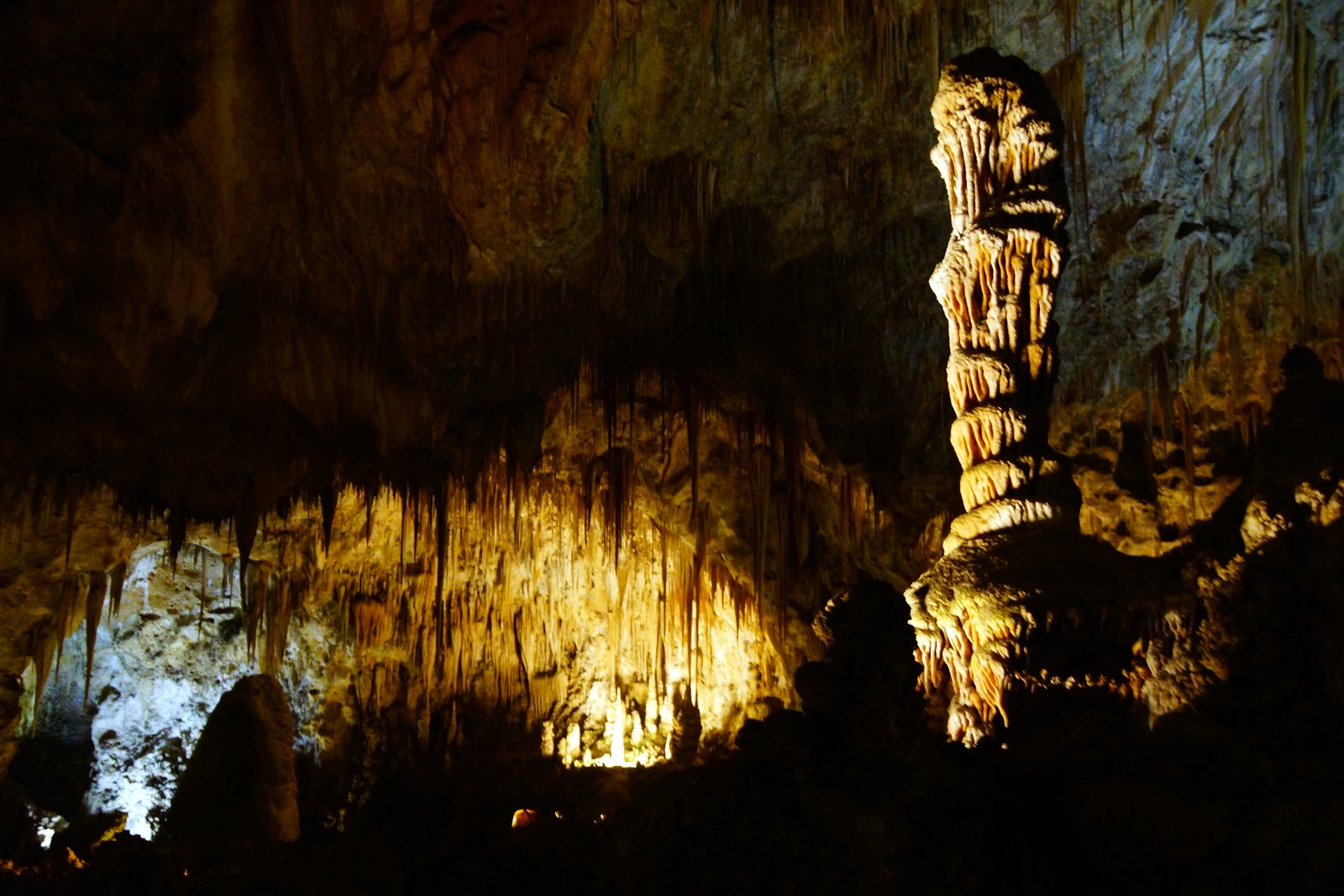
It's difficult to convey just how big this cave is.


The size of the Big Room was enormous,...

...and finally, some people to help give it scale.


My flash caught the multitude of drips falling.


Crystal Spring Dome

The base of Crystal Spring Dome drips into a shallow pool.

This and many other giants are dry as a bone and no longer growing.


I hate to be negative, but the tour was much less than optimal for us. There were 55 people on the tour - far too many for all of us to hear what Ranger Anna had to say.  It also seemed rushed with very little time for pictures and you know we are all about the pictures!  I think next time we will skip the tour and stick to the self-guided portions of the cave.

A large crowd gathering for the King's Palace Tour.

David noticed right away something was amiss.  Ranger Anna confirmed, the stalactites were no longer vertical because the whole chunk had fallen from the ceiling millions of years ago.


We were introduced to helectites in the Timpanogos Cave near Salt Lake City.  As we found on that tour, there has been no satisfactory explanation for their gravity-defying formation in every direction.


This hall was blasted open 83 years ago and became active.  It shows how slowly the formations grow - 1/4 to 1/2 inch in 83 years.


In case it is not apparent in the picture below - that is light coming through the cave curtain - a very nice effect indeed.


There was a time when this cave was full of water, now there is very little.  This little pond looked shallow due to the extremely clear water, but it was about 8 feet deep.


Joani caught me with a strange look (I hope I don't usually look like that), but the food was very good - I promise.  Sam can vouch for it as well.  Joani took hers to go and left it in the car.  Somehow, Sam figured out how to pull the lid off of the container and eat the soup without spilling a drop, as far as we could tell.


Not really wanting to return the same way we came, we opted for a big loop that took us by the Guadalupe Mountains National Park.  We found there are no roads in the park (other than a few requiring high-clearance, four-wheel drive).  This park is almost exclusively geared for backcountry hiking and camping.  From the information at the Visitor's center, the hikes were all long and strenuous with the exception of the Pinery Trail.


The Pinery Trail started from the Visitor's Center and meandered through a variety of indigenous flora.  Most of the plants were nicely labeled, but a few signs left us confused.  Still, we learned about quite a few interesting plants.


 Texas Madrone is a member of the heath family along with blueberry, huckleberry, cranberry, azalea, and rhododendron.

 Sotol (SOH-tole)
Stems and stalks are used for fuel and building houses.  Indians roasted and ate the flowers stalks and used the narrow leaves to fashion baskets, mats, and ropes.


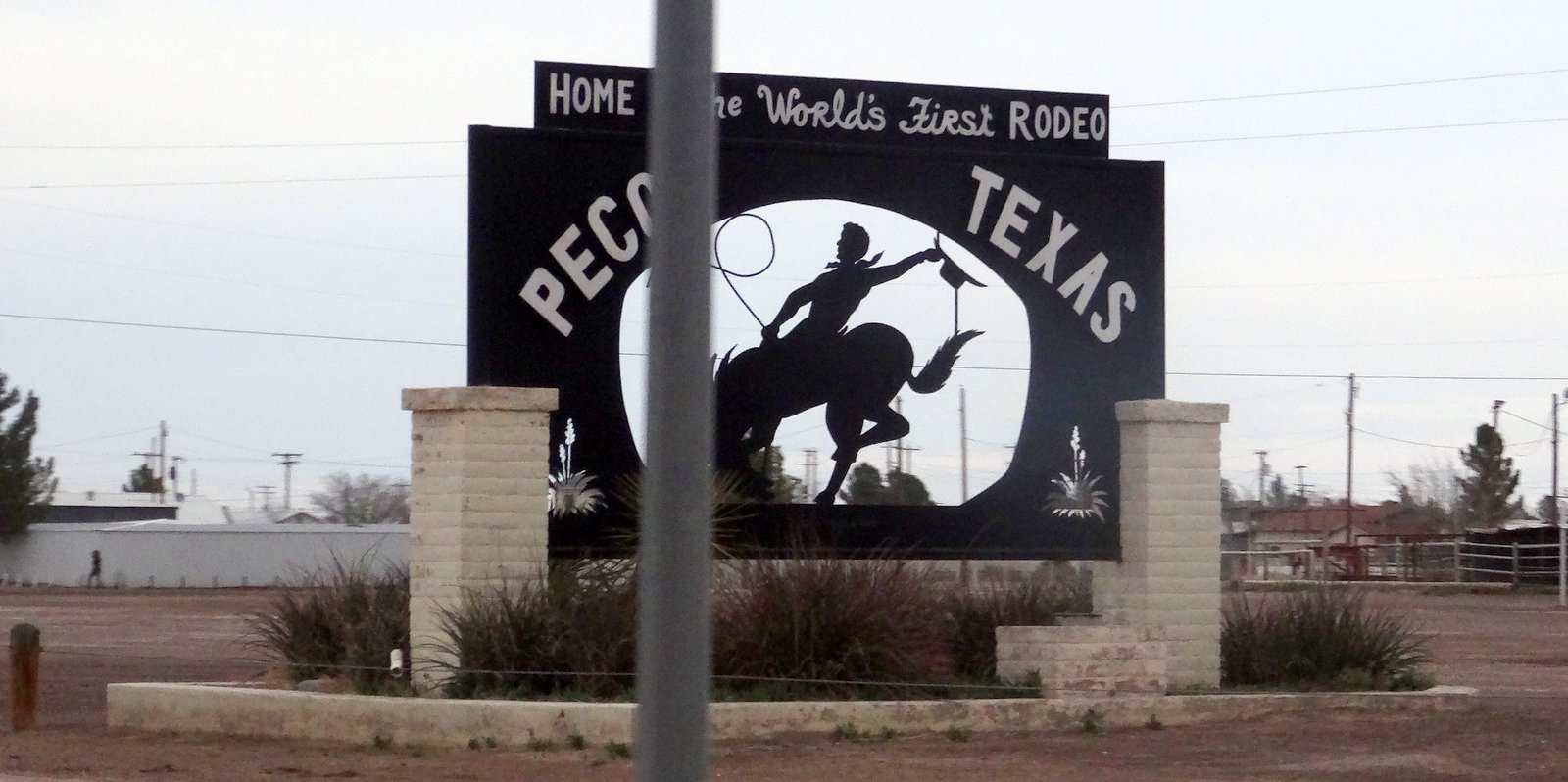
After a long drive (nearly 300 miles), we decided to head into town for some take-out Chinese.  Joani tried several times to catch the Pecos sign and this was the best she got.  I suppose I could have pulled over to the side of the road to help, but I was just too tired and hungry to go back.  I think the picture of the street below gives a good indication of just how dusty the town was.