Showing posts with label North Dakota. Show all posts

Thursday, August 9, 2018, Even more Bison!


We headed back into Roosevelt National Park today in search of more wildlife. Behind the Park's Visitor Center is the Maltese Cross cabin where Teddy Roosevelt stayed when he visited the area in the 1880's before he had his own Elkhorn Ranch built.


I noticed the rock formation below and decided it looked a little like a prairie dog (or maybe a turtle or maybe I had too much time to think about it while we waited on the construction traffic.) I'm pretty sure I can see this fat little doggie smiling.


Near the start of the loop drive, the Peaceful Valley Ranch house remains from a time not too long ago when a few hardy souls tried to make a living in the remote and rugged land where drought and blizzards could easily wipe out an entire herd in a season. Since the park was established in 1947 the area now only supports wild herds of bison, elk, horses, deer, pronghorn antelope, bighorn sheep and, of course, prairie dogs.


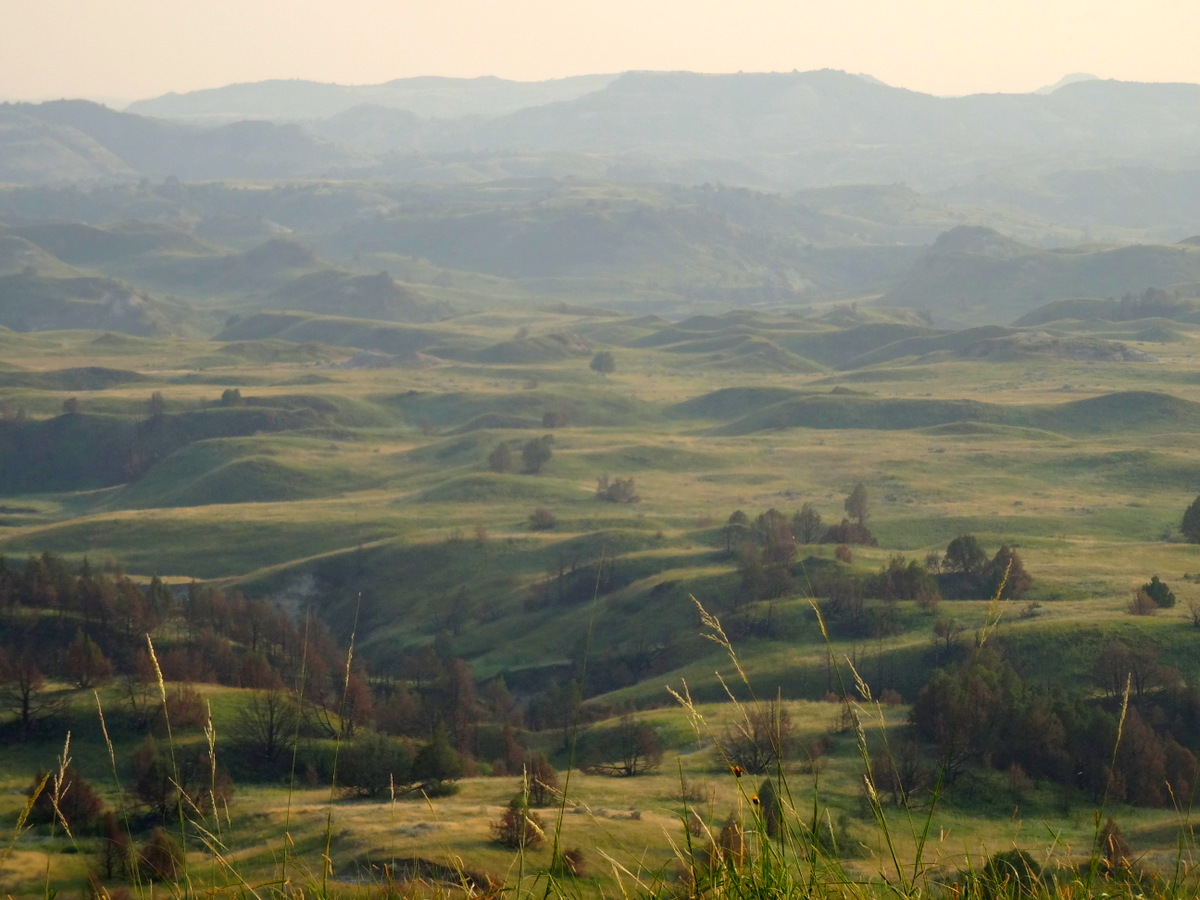
One of the few times we left the car was for the Wind Canyon Trail. A short hike (0.4 miles) atop a cliff edge above the Little Missouri River, it offered beautiful panoramic views of the North Dakota badlands.


From the river overlook, we could hear the bison from several miles away. They sounded much closer than they actually were. I could just barely capture them with the maximum telephoto setting.


The male bison often preferred solitude over the herd. We saw several along the drive that were just enjoying the peace and quiet except for the occasional gawking tourists.


I think this guy was a natural performer putting on a little show for us.


The guy below was conserving his energy so the only thing he moved was his tail. It was so quick that it took several shots to actually get it anywhere but on the ground. Of course, in a still shot, it just looks like he had a curly tail.  


We had one bison who ambled alongside the road before deciding to actually walk on the pavement. When I looked in the mirror I knew I had to have this shot.


Another bison right at the edge of the roadway found a post to use for scratching his tough hide.


We could not get very close to the extremely skittish pronghorn antelope so all of our pictures were from a long distance - I estimated at least a quarter mile. I think we were just lucky to see them at all.


It was deep dusk when we spotted these deer. A slow shutter and a rare moment without moving let us get this shot that made it look much more like midday than nearly dark.


We always enjoy the color of a beautiful sunset to close our visit to any National Park.

Wednesday, August 8, 2018, Roosevelt NP Geology


We headed back into the park a little earlier today to see what we missed in the dark yesterday. We found the colorful exposed layers to be especially photogenic and hopefully we were able to capture some of the beauty that makes Theodore Roosevelt National Park so special. 

Geology absolutely intrigues me.  This park has hijacked my research interest that resulted in finding a blog written by John Bluemle, PhD called North Dakota Geology. (The excerpts and information that follow, along with links to pertinent pages, are from his blog.)

"General Alfred Sully, preparing to cross the badlands in August of 1864, described them as “hell with the fires burned out.” Theodore Roosevelt, who lived for a while in the Little Missouri Badlands in the 1880s, described them as “fantastically beautiful.”"

Concretion pedestals known as “hoodoos,” mushroom-like shapes perched on stalks of clay, are seen throughout the park.

The last of the Ice Age glaciation events is the most important to North Dakota. This event occurred between 25,000 and 12,000 years ago.

Ice sheets, perhaps 400 feet thick (and as much as a mile thick in the northeast corner), covered about three-fourths of the state. The ice sheets extended as far south as the Missouri River.

This corner of North Dakota was not under glaciers but was heavily influenced by them.  The glaciers changed the direction of the Little Missouri River and that started the erosion process that carved Roosevelt's topography.

Late in the Cretaceous, beginning about 70 million years ago, and continuing through the Paleocene, until about 56 million years ago, western North Dakota’s climate was subtropical. Trees up to 12 feet in diameter and more than 100 feet tall grew in a setting similar to today’s Dismal Swamp in Virginia, or the Florida Everglades, with meandering rivers, swamps, and vast forested floodplains.”

Another wild animal first for us in this park - wild turkeys! How can they possibly survive an environment with wolves and foxes?


"...in the South Unit of Theodore Roosevelt National Park, a lignite seam burned from 1951 until 1977." (Lignite is a layer of "soft" coal.)


The hoodoos below were one of my favorite subjects with the sun just peeking over the hill spotlighting the tops of the structures.


There were a few wild horses in view but not really close enough for anything but an extreme telephoto shot.


The bison were not in the mood to mingle on the roadway today so this was our closest encounter - you almost could not distinguish them as bison. 


We had just enough time before sunset to drive to the Painted Canyon Overlook. The overlook Visitor's Center and parking area were shared with a rest area along I-94 at exit 32. That had to make this one of the most spectacular Interstate Rest Areas in the system. Unfortunately, there was no cloud drama for a really nice sunset and the air was very hazy with smoke from some far off fire (in Idaho, I think), so we just watched as the sun slowly sank below the horizon.

Tuesday, August 7, 2018, Move to Medora, ND, Roosevelt NP Wildlife


We got an early start for today's short drive to Medora, ND. It was only 134.2 miles (89,425.1 total) directly west along I-94. It was amazing to see the distinct and rapid change from flat grassland plains...


...to the stark and barren looking badlands that comprise the Theodore Roosevelt National Park. The closer we traveled to Madora, the more the landscape changed.


Unlike the Badlands National Park in South Dakota, this area had quite a bit of vegetation. It was a beautiful drive that had Joani flitting from one window to the next trying to take it all in.


We were in and settled at the Medora Campground so early and the National Park was so close (campground entrance to National Park entrance - 1500 feet) that we decided to get right to it. After a frustrating delay due to road construction in the park, we were treated to our first close-up views of the North Dakota badlands.

Erosion has exposed some wild and wonderful geologic oddities. Layers of relatively hard sandstone shields the underlying clay creating the "Hoodoos" that reminded us of our visit to Goblin Valley State Park in Utah.

We thought this drive would be all about scenery, but it quickly became all about wildlife!

I left these first few uncropped and no zoom was used.  At first, no problem.  But they were headed our way and we had no option but to turn off our engine and watch.

We felt somewhat safe, snug in our car.  Holding the camera out the window and the waning light of day (8:18 pm) resulted in lackluster photos, but I think they captured the enormity of these magnificent creatures.

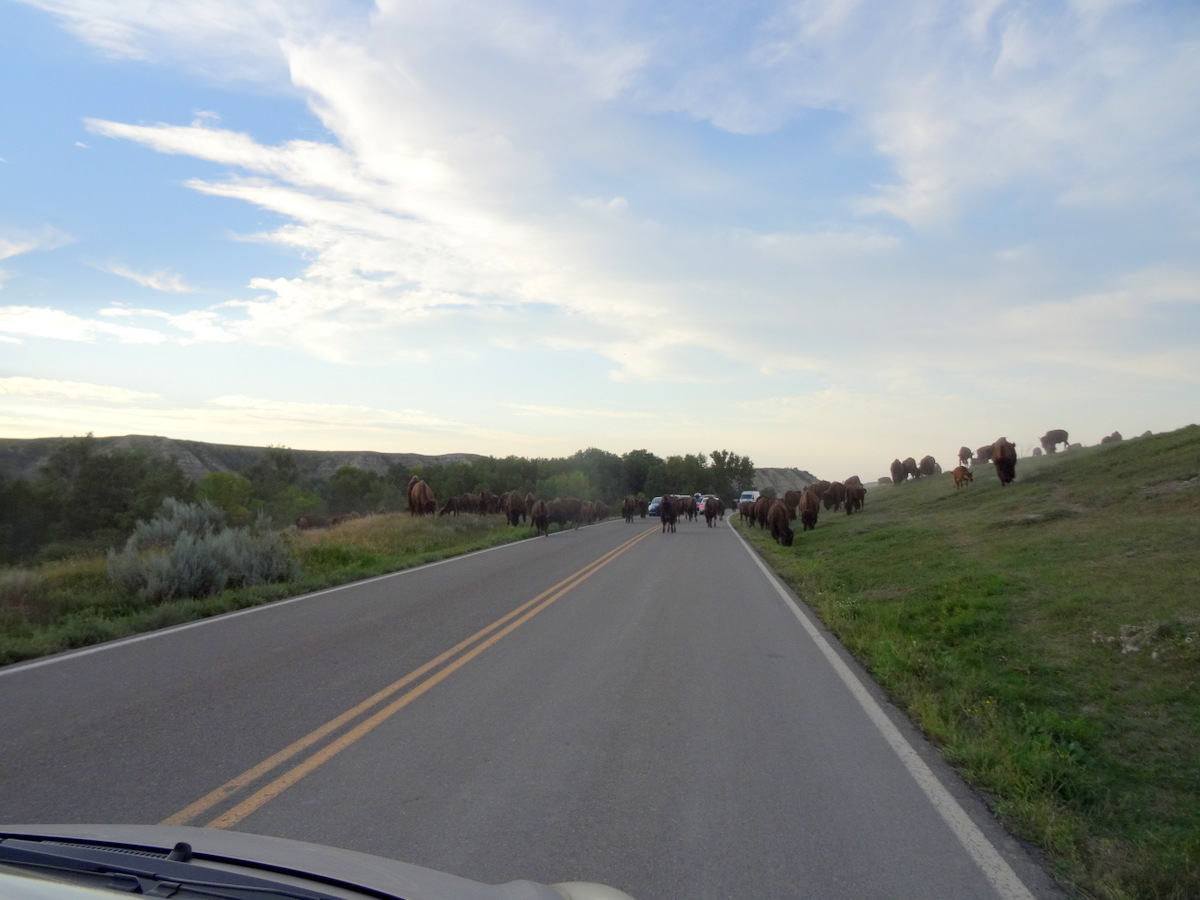
 They were passing us in droves, seldom showing any curiosity.


David managed a few shots with the "good camera."  How he managed to manually focus on these rapidly moving targets, I'll never know.

Awww!


 This bad boy was huge! The top of his head was as tall as the female in front of him. I swear he was taller than our car and in a battle between him and the car, I'm sure he would win.

 After the young lady (on the right) relieved herself, this pushy bad boy decided to examine the results (it went on for a whole minute.)

 And then he turned his attention toward our car.  At this point, I asked David to roll up my window (not wanting to stop snapping pictures).  He informed me he would need to start the engine and this may not be a good time to do that.  Fair point.

 The last of the herd (we thought) was trying to stare us down.  We didn't blink, so he eventually moved on.

 Well, it turned out there were about a dozen stragglers trying to catch up.  It was amazing to see these creatures at full speed.

This bull, bringing up the rear, was another huge one. He was at full charge running through a prairie dog town, trying to catch up to the herd.


There were at least four prairie dogs peeking out, wondering what was going on.

There are prairie dog towns spotted throughout the park, three are right along the road.

   He was braying at the group (or was he warning us) with a bellow that said "you young whippersnappers better listen and get in line" or was it "Hey, wait for me!"

 The sun was starting to show its colors.

 A few wild horses caught our attention and were a portent of things to come.


  We finally found a high point turnout that allowed us to stop and watch the sunset.

 But watching the sun go down meant we would traverse more than half the park at dusk and then dark.


It was a good thing we still had two more days to explore the park.

 As we rounded a corner, David noticed a seemingly endless trail of wild horses of every color and size.

 We tried to count, but they were moving and we were moving, so we had to roughly estimate and came up with at least 30 maybe more.

 The combination of low light, the moving horses and a moving car made for bad pictures, so...

...I asked my chauffeur to stop and give me a chance at a picture, but the horse was still on the move and it was still dusk.  Oh, well.


David had to say, "I hope we don't meet another herd of Bison in the dark."  So of course, that's just what did happen.  Impossible to say how many since we could barely see them.