I liked the size of Topeka, KS. It was large enough to have most anything you might need but small enough to easily navigate.
If I have counted correctly, this was the 21st capital city we had visited and it made quite an impression on us. We began our day parking in the free underground lot. There was ample space and the respite from the sun was certainly appreciated.
We arrived about 30 minutes early for the "Dome Tour" and had a chance to look around the new visitor's center. The building had recently undergone a thorough restoration that returned the capital to its original beauty. It also updated the heating and air conditioning and electrical and security systems. Of course, things are a bit pricier today - the capitol was originally built at a cost of $3 million; the restoration cost more than $330 million.
I had no idea we would soon be standing outside on the narrow walkway surrounding the cupola near the top of the dome.
When the Capitol was finished in 1903, after 37 years of construction, there was no debt on the building.
The outer copper dome extends approximately 75 feet above the inner dome that you see from the rotunda.
Those stairs you see curving around towards the upper reaches were the start of the 296 we climbed on our way to the top of the dome. It was very interesting to see the view from below before actually starting our climb.
This is the view from the fifth floor of the building where we started the Dome Tour.
Before the restoration, everything you see; copper, bronze and brass was just black.
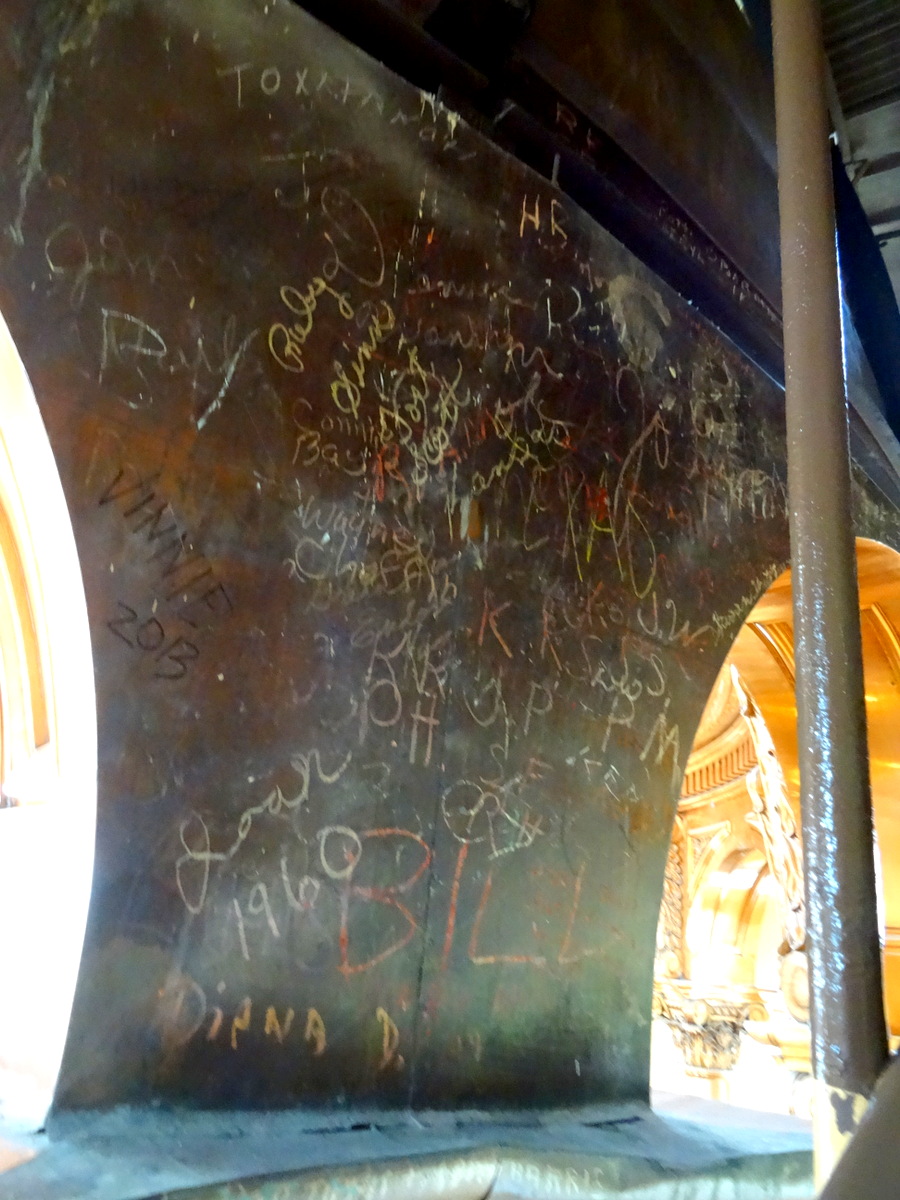
Here you could see that only the side visible from below was painted with the copper paint. (Only columns were faux painted, the rest is real copper, brass or bronze.) The graffiti was thanks to kids who were free to roam the entire building, unsupervised, in the early years (1903 through 1970). Now on the National Historic Registry, it is forbidden to "deface" the structure with any new markings or remove the old. Our guide, Patti, told us it was amazing that in all of the 60+ years kids played in the upper reaches of the building there was never anyone hurt.
In the buildings early years, there were absolutely no restrictions as to where you could go, young or old. Doors with locks were added in the '70s.
Once we were above the inner dome a glance up had me thinking twice about whether or not I really wanted to climb all of those steps.
How awesome is that! We're told this is the only capitol that has a tour like this.
The restoration intentionally left uncovered the backside of pillars containing graffiti of years ago.
David does not have a fear of heights, but he has a strong dislike of them. (He always goes for it anyway.)
The flourish below was actually the highest point you could see from the rotunda floor if you looked past the chandelier. The original chandelier was removed and donated to the war effort in the '40s so it was recreated as part of the renovation. The new lighting was installed on a winch so that it could be lowered for cleaning and maintenance twice a year.
There was a fairly new aluminum platform above this flourish that housed the winch. The chandelier can be lowered to the first floor, barely fitting through the rotunda openings on the second floor.
The other side of the glass panes below was the top of the dome as seen from the inside of the working floors of the building. We were between the dome you see from the inside and the dome you see from the outside.
The inner dome is composed of 256 glass panels. Each is a half inch thick. Only two have needed to be replaced over the years.
Those crazy kids climbed the steelwork to see who could sign their name the highest.
Patti told us the kids would zip up these steel structures like ladders. What an amazing playground this would have been!!!!
Some of the more insane kids actually crawled out onto the cross members to sign their names. Patti was right - it was a miracle no one was hurt playing around up here.
Finally near the top, on the last few steps of the spiral stairs, this was the view looking down if you were brave enough to actually look down.
Only one young woman was too bothered by the heights (seen far below). I was amazed she made it as high as she did.
There was very little air circulation between the inner and outer domes so it was pretty warm (a thermometer at the top of the inner dome registered 86 degrees.) Dome tours were canceled in the event it was too hot so it was a good thing to try for the early tour. When we stepped out onto the cupola balcony the fresh air was a welcome relief. The balcony was so narrow it was disconcerting to squeeze between another person and the railing and the wind was blowing more than I would have liked so I took some pictures, tried not to look down too much and then retreated back inside.
This is all you can see of Ad Astra, from the catwalk (if you lean out a little).
The statue is named for the state motto: Ad astra per aspera, “To the stars through difficulties.”
We returned from the dome tour with just a few minutes to spare before the capital history tour. We learned the capitol was built a little at a time. Construction was begun on the east wing in 1866. The west wing was begun in 1879. The central building joining the two was started in 1886. The building was declared officially complete in 1903 after 37 years of construction. Ad Astra, the 4,420 pound, 22' 2" tall statue on top of the dome, was not set in place for another 99 years in 2002.
Below was the Senate chamber. Like all of the other rooms, every bit of the woodwork and ceiling detail had been painted beige many years ago. The explanation was that soot from the gas lamps had darkened everything and someone decided to brighten it up with a fresh coat of paint. Through the years everything was repainted many times and it was all painstakingly removed during the restoration.
Looking at the ceiling it was easy to see why the restoration took 13 years. I'm just happy they were finished before we were ready to visit.
Even the murals were covered with the beige paint. They had to be replicated from detailed drawings in the original plans.
At some point, a third floor had been added to the library. They determined they did not need the extra shelf space so it was removed to return to the original design providing a better balance to this nice room. The second floor is glass to allow better distribution of light.
The library is the only room that was lit with electricity from the very beginning. The state librarian, Annie Diggs, insisted on it. (Annie was small, 4 foot 11 inches, but wielded power.)
The oldest book in the State Library, inside the Capitol, is from 1741 and written by Sir Francis Bacon.
I noticed David preferred to not walk on the glass keeping to the cross beams.
The first floor had eight murals painted by David H. Overmyer dated 1952 and 1953. I love this style and the colors were amazing.
The beautifully finished lowest level (previously the basement) was full of pictures depicting famous Kansans.
 The Kansa warrior, Ad Astra, Sculpted by Kansas artist Richard Bergen
I still can't believe they let us walk around on this little balcony! What a blast!
The Kansa warrior, Ad Astra, Sculpted by Kansas artist Richard Bergen
I still can't believe they let us walk around on this little balcony! What a blast!
The Kansas Capital tours were very nice and I suspect this will remain one of our favorites even if we someday see all fifty.