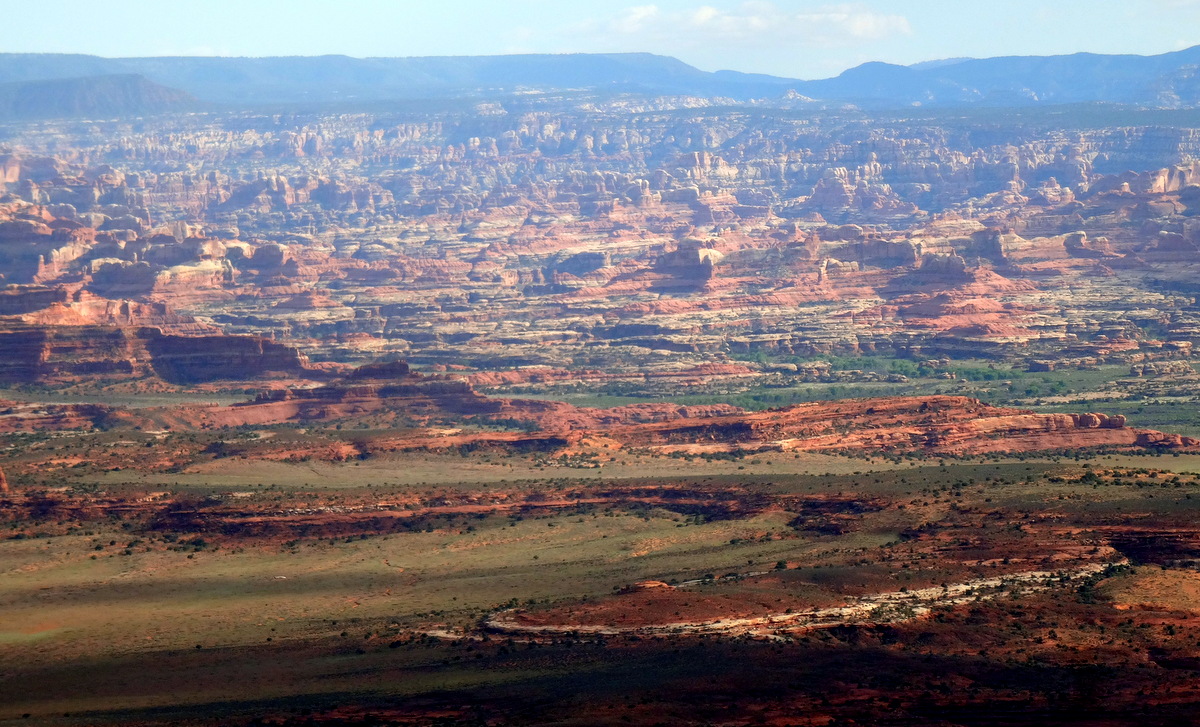
It was difficult to believe our week-long stay in the Grand Junction area was nearly at an end. We decided to visit one of the last National Park System sites in the region we had not yet seen. It was a long drive to Dinosaur National Monument but our route took us on a scenic byway so we saw some interesting geology, signs for Pintado Canyon (just signs - no entrance or parking area) and a steep up and over some intervening mountains.
The monument had two distinct halves. Fossils were only unearthed on the Utah side. The Colorado side was all about sweeping vistas and canyon overlooks. We started with the Utah side in Jensen, UT.


This guy at the Visitor's Center was recreated based on bones unearthed at the nearby dig site. A lot of supposition and imagination went into this model as well.

Just a short drive, or tram ride, from the Visitor's Center, was the Dinosaur wall enclosure protecting the Carnegie Dinosaur Quarry.

Dogs are not allowed on the trams. If you have a furry friend, they allow you to drive your car to the quarry.
Approximately 1,500 dinosaur bones remain partially embedded in rock in the quarry. It's difficult to comprehend how the region changed over the eons resulting in this collection of fossilized bones. The theory is that there was a river here long ago. Animals lived and died along the banks of the river for millions of years. When they died their bones were covered by mud. Eventually, as the earth's crust shifted the area was covered by lakes or oceans and sediment piled on the mud. With time and pressure, the mud became rock and the bones fossilized. Much more recently, the crust shifted and uplift occurred again bringing the layers of rock to a 70-degree incline. Erosion and weathering finally exposed the bones creating what we see today.

The Morrison Formation is the layer of rocks that preserves what's left of the Morrison world. It is about 800 feet thick at Dinosaur National Monument. The quarry rocks were formed in a single river channel, about 149 million years ago. The Carnegie Quarry is only a small part of the formation.
The size of the wall and the number of bones was impressive but this was just one small exposed area. The layer of rock containing bones could have continued under any or all of the hills in the park. When I asked why these bones were no longer being excavated I was told museums were full and there was a push to protect the site for future generations. I'm not sure that was a legitimate answer but I know I have no interest in continuing the dig.

Earl Douglass found the first bones in 1909. Crews worked for 15 years to excavate and ship the fossils to museums.

The first fossils that Douglass found were eight tail bones of an Apatosaurus. They were arching out of the ground in a life-like position.

Excavation records show that what you see here is the main bone layer. This rock layer continues outside and beneath the building and there are many more bones in it.

Paleontologists have collected fossils from almost 400 different dinosaurs. There are 1,500 fossil bones remaining from 100 individual dinos.

This quarry yielded the remains of over 500 (mostly huge) dinosaurs. The remains of small creatures were swept away in the fast-flowing river.

The most common dinosaur in the quarry is Camarasaurus.

Joani snapped a few of the historical photos when bones were being excavated.

Between 1909 and 1924, several hundred tons of fossils were collected from this location and sent away to museums and universities across the country.

Between the 1950s and 1990s, excavation focused on removing just enough rock to expose over 1500 fossils.
Beautiful examples of the power of tectonic movement were everywhere. Keep in mind that each layer of sediment was, at one-time, level, at the bottom of a lake or ocean as its thickness grew. The different colors represent different minerals being deposited in each layer as the conditions at the time varied.


Humans have lived in the area for around 10,000 years. In that time it has not changed significantly and signs of that early habitation remain in the form of pictographs. Here it looks like early inhabitants recorded the arrival of Martians.

Approximately a thousand years ago, the Fremont people lived in this area.

Swelter Shelter includes both petroglyphs and pictographs.
Sure enough, the Colorado side of the park posted a sign letting visitors know they would not be seeing any dinosaur bones here. It was, however, an enjoyable drive. Looking towards the Utah side, it was clear why there was never a road through the park connecting the two sides - there was some extremely rugged terrain - road building would be extremely challenging.


We spotted this strange creature at one overlook parking area. He looked like a direct descendant of the dinosaurs that once roamed these lands. Fortunately, he was only about 5 inches long not including the 2-inch tail and had no interest in eating us.

"The most famous and outstanding feature of the horned lizards is of course even more fantastic than its thorns - it can squirt blood from its eyes. Some can hit enemies up to 10 feet or 3m away. This unusual defense seems to be used quite often on dogs if ever they dare to get close enough." Fact Zoo

Phrynosoma hemendes, Greater Short-horned Lizard (maybe)
I'm so glad Sam was in the car when David spotted this guy.
The flowers were so abundant the distant fields were tinged with their color.